Transliteration:( Wa mai yaqul minhum inneee ilaahum min doonihee fazaalika najzeehi Jahannam; kazaalika najziz zaalimeen (section 2) )
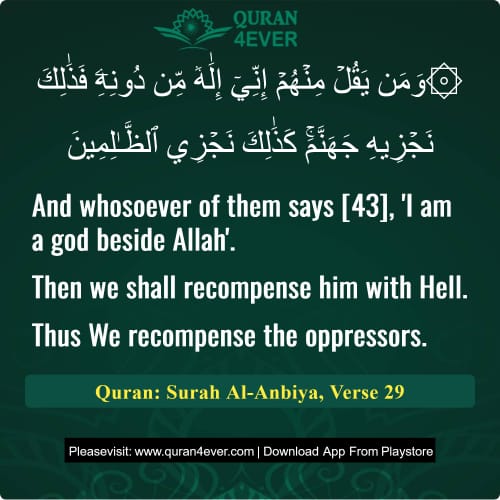
"And whosoever of them says [43], 'I am a god beside Allah,' then We shall recompense him with Hell. Thus We recompense the oppressors."
This verse makes it clear that even the idea of claiming divinity is impossible for angels.
They are innocent and humble, and the notion of one of them saying “I am a god besides Allah” is completely absurd.
Just as Allah says in another place:
“If the Most Merciful had a son, I would be the first to worship him” — which is a rhetorical statement, not a possibility.
Some scholars interpret this verse to refer to Shaitaan (Satan), who once lived among the angels.
Though not an angel himself, he shared their company, which is why the pronoun “of them” (منهم) is used here.
This verse is a warning that anyone who falsely claims divinity—whether jinn, angel, or human—will face Hell.
Such a claim is the height of oppression, and Hell is the rightful end of all oppressors.
The tafsir of Surah Anbiya verse 29 by Ibn Kathir is unavailable here.
Please refer to Surah Anbiya ayat 26 which provides the complete commentary from verse 26 through 29.
(21:29) And if anyone of them were to claim: “Indeed I am a god apart from Him,” We shall recompense both with Hell. Thus do We recompense the wrong-doers.
There is no commentary by Abul Maududi available for this verse.
For a faster and smoother experience,
install our mobile app now.
Related Ayat(Verses)/Topics