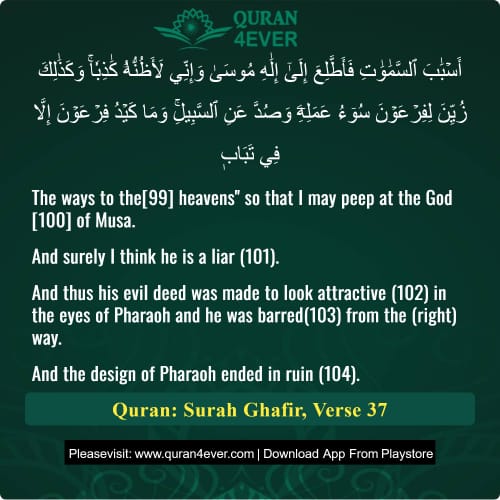
Transliteration:( Asbaabas samaawaati faattali'a ilaaa ilaahi Moosaa wa innee la azunnuhoo kaazibaa; wa kazaalika zuyyina li-Fir'awna sooo'u 'amalihee wa sudda 'anis sabeel; wa maa kaidu Fir'awna illaa fee tabaab (section 4) )
"The ways to the [99] heavens, so that I may peep at the God [100] of Musa. And surely I think he is a liar [101]. And thus his evil deed was made to look attractive [102] in the eyes of Pharaoh and he was barred [103] from the (right) way. And the design of Pharaoh ended in ruin [104]."
Pharaoh imagined that by constructing a high tower, he could reach the heavens physically and find access to the domain of Musa’s God. This reflects his complete delusion and mockery, treating the unseen world as if it could be accessed through physical height and effort.
Pharaoh's statement that he might "peep at the God of Musa" shows a flawed understanding—believing Allah to be confined to a place. In Islamic belief, Allah is beyond space and direction. He is neither in a specific place nor spread across places. Heaven is a place for provision—not the place of the Provider.
Though Pharaoh outwardly mocked Musa, calling him a liar, this verse implies he had inward conviction of Musa's truth. His sarcastic tone betrays an inner fear and recognition that Musa might indeed be sent by the true Lord. Had he been fully convinced of his own claim to divinity, he would have boldly denied the very idea of another God—yet his tone is cautious and revealing.
His evil acts—false claims of divinity, rejection of a Prophet, and arrogance—became embellished in his own view, making him believe his rebellion was valid. This is the effect of persistent sin: it blinds a person to truth and makes misguidance appear appealing.
Because of these compounded sins, Pharaoh was prevented from accepting the truth. His arrogance and the whisperings of his soul and Satan became a veil between him and guidance.
All of Pharaoh’s plans to oppose Musa—whether to intimidate, kill, or humiliate him—failed completely. In the end, Musa was victorious, and Pharaoh’s legacy became one of ruin and humiliation. This is a recurring pattern in history: truth always prevails, no matter how dominant falsehood may temporarily seem.
The tafsir of Surah Muminun verse 37 by Ibn Kathir is unavailable here.
Please refer to Surah Muminun ayat 36 which provides the complete commentary from verse 36 through 37.
(40:37) the highways to the heavens � and have a look at the God of Moses, although I am certain that Moses is a liar.”[55] Thus Pharaoh’s evil deed was made to seem fair to him, and he was barred from the Right Path. Pharaoh’s guile only led him to his own perdition.
55. Pharaoh addresses these words to Haman, his minister, interposing in the speech of the Believer in a way as though he has no regard for what he was saying. Therefore, he turns away from him arrogantly and says to Haman: Build me a high tower so that I may climb it to see where the God of whom this Moses speaks, lives. For explanation, see (Surah Al-Qasas, Ayat 38) and E.Ns thereof.
For a faster and smoother experience,
install our mobile app now.
Related Ayat(Verses)/Topics